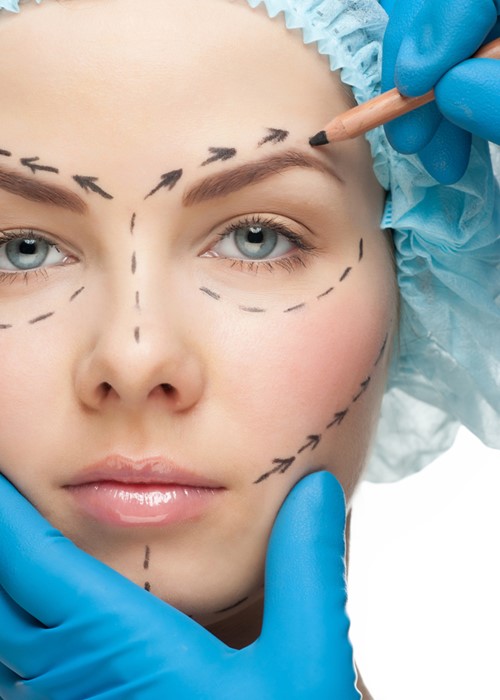
Before posting a selfie, many people feel the need to minorly alter their virtual appearance with the swipe of a finger, there’s no harm in that, right?
Well the expectation for “perfect” bodies and faces creates the desire to alter one’s look in reality, and it’s f***** up.
Applications such as Face Tune and Photoshop create an unrealistic idea of natural beauty which is boosting the plastic surgery business. When the American Academy of Facial Plastic and Reconstructive Surgery took a survey in 2017, 55% of surgeons said patients’ motivation was to look better in selfies, up from just 13% in 2016.
Having a “virtual nose job” is all good fun until body dysmorphia causes one to make these changes to their physical body.
I’m not saying that grown adults can’t get plastic surgery if they want to, go ahead, it’s not my body…however the issue is the fact that teens and young adults feel a need to get plastic surgery because of the media. It all starts with the influence social media has on adolescents. Young people and adolescents are more manipulated by social media just as they are by anything because of their growing brains.
Applications like Snapchat offer filters which eliminate blemishes, plump lips, thin noses, whiten teeth, and virtually change the structure of one’s face. By getting used to how your face looks everyday with the adoption of these filters, it’s only a matter of time before they influence the way you look at yourself in the mirror without them.
This is where the issue lies, as a society we are glorifying this “perfect” self-image which can only be attained through filters or fillers. These filters target parts of our bodies which we are told to be insecure about by social media, “my lips are so small” “I have wrinkles” “ugh my nose is so big!” But as a new generation grows, filters and Face Tune change/ “optimize” features telling young people that they should look a certain way. This has led to a huge jump in plastic surgery operations stemming from insecurity.
A piece from the Independent discusses Dr. Esho who is a cosmetic doctor at The Esho Clinic. The specialist labels this phenomenon “Snapchat dysmorphia.”
“Previously patients would come into clinics with pictures of celebrities or models they admired and wanted to look like,” he explains. “But with the introduction of social platforms and filters over the last five years, more and more patients come into clinics with filtered versions of themselves as the goal they want to achieve.”
Sure, Face Tune is a tool that can be used to help patients see what they will look like after surgery, however, it should not be used by teens on a daily basis. People are becoming so familiar with the way they look in a selfie, they begin to dislike the way they are in real life. Some doctors are even saying that people will enter their office and show them an edited picture that is impossible to recreate in a healthy and safe way. Making one’s skin perfectly smooth? Not going to happen. But paying a couple thousand dollars to get a nose job, book an appointment.
VICE explored this phenomenon with a mini documentary episode following two young women who got plastic surgery because they wanted to look like their face tuned selves and look better in selfies. One of them was 19, reiterating the idea of how easily manipulated we are by social media, so much that we are willing to go under the knife for it.
While there is no problem with changing your physical appearance to fulfill your personal needs, the idea of a societal push to conform to unrealistic and “perfect” looks is f****** up.
Works Cited
Anumero_1. “Are Digital Facelift Apps like Facetune Harmless Fun, or Should Women Be Afraid?” Images, 20 Mar. 2019, images.dawn.com/news/1181743.
Balakrishnan, Janarthanan, and Mark D. Griffiths. “An Exploratory Study of ‘Selfitis’ and the Development of the Selfitis Behavior Scale.” International Journal of Mental Health and Addiction, vol. 16, no. 3, 2017, pp. 722–736., doi:10.1007/s11469-017-9844-x.
Hosie, Rachel. “People Want to Look like Versions of Themselves with Filters Rather than Celebrities, Cosmetic Doctor Says.” The Independent, Independent Digital News and Media, 6 Feb. 2018, http://www.independent.co.uk/life-style/cosmetic-surgery-snapchat-instagram-filters-demand-celebrities-doctor-dr-esho-london-a8197001.html.
Keles, Betul, et al. “A Systematic Review: the Influence of Social Media on Depression, Anxiety and Psychological Distress in Adolescents.” Taylor & Francis, http://www.tandfonline.com/doi/full/10.1080/02673843.2019.1590851.
Keles, Betul, et al. “A Systematic Review: the Influence of Social Media on Depression, Anxiety and Psychological Distress in Adolescents.” Taylor & Francis, http://www.tandfonline.com/doi/full/10.1080/02673843.2019.1590851.
“Media Influence on Teenagers: Social Media, Movies, YouTube and Apps.” Raising Children Network, 17 Nov. 2019, raisingchildren.net.au/pre-teens/entertainment-technology/media/media-influence-on-teens.
“New Stats: AAFPRS Annual Survey Reveals Face Of Plastic Surgery Goes Younger.” AP NEWS, Associated Press, 11 Feb. 2020, apnews.com/2fd0f769df827c99aeb279b89de8dd96.
Ongley, Hannah. “Are People Getting Plastic Surgery to Look Like Instagram Filters?” Vice, 13 Aug. 2018, http://www.vice.com/en_asia/article/ne59qd/are-people-getting-plastic-surgery-to-look-like-instagram-filters.
Rajanala, Susruthi. “Selfies-Living in the Era of Filtered Photographs.” JAMA Facial Plastic Surgery, American Medical Association, 1 Dec. 2018, jamanetwork.com/journals/jamafacialplasticsurgery/article-abstract/2688763#qvp180001r7.
Rsph. “#StatusofMind.” RSPH, http://www.rsph.org.uk/our-work/campaigns/status-of-mind.html.
Staff, Broadly. “I Got Surgery to Look Like My Snapchat and Facetune Selfies.” Vice, 7 Dec. 2018, http://www.vice.com/en_asia/article/43974w/i-got-surgery-to-look-like-my-snapchat-and-facetune-selfies.
Tolentino, Jia. “The Age of Instagram Face.” The New Yorker, http://www.newyorker.com/culture/decade-in-review/the-age-of-instagram-face.


7 replies on “Filters to Fillers”
I think this is so important. We’ve always been a looks-based culture, but now we’ve become such an image-based culture and some of the effects are so toxic. While it does affect both men and women, I feel like the standards for women to perform and conform are a bit higher in Western culture. Granted I feel like this is slowly evening out, in part due to apps like Instagram and Snapchat and then the follow up of having to meet up in real life and look the way you portray yourself on screen. It’s so disheartening to hear of people so young going under the knife, but I personally know some individuals who have done so themselves, so I guess at this point it’s become universal. Or I guess universal for those who can afford to be that caught up in their own appearance.
LikeLike
Before reading this post I had never really considered the effect that filters might have on an individuals self-image/psyche. However, It is hard for me to blame the software or the application. Rather, I find it really saddening that people feel the need to conform to societal standards of beauty. Like you said, before apps such as facetune or snapchat people still came in for plastic surgery, but they held up pictures of celebrities or other representations of “beauty”. Therefore, while these apps might make it easier to visualize changes to your appearance, I don’t necessarily think that they cause people to wish they looked different more than in the past. I feel like as long as mirrors and the media have existed people have been wishing their reflection looked different. Hopefully the narrative will continue to shift towards self-acceptance and self-love in the coming years. Do you personally have any solution or plan of attack to address the issues you brought up in this piece (such as increased plastic surgery, etc). I realize a large portion of the problem likely stems from human nature itself, but I would be curious to hear more about what you believe could be done to combat this wave of superficiality.
LikeLike
I agree, it seems like everyday more and more people are being influenced by the media to change their appearance. Just a couple years ago when Kylie Jenner started getting lip fillers everyone seemed to follow. By the looks of it I think people see these pictures of people like Kylie and think that is what beauty looks like and that they too need the fillers. When in reality they probably never even had a problem with the way their lips looked until they started seeing these pictures with girls and their news lips. Snapchat offering these filters where they make it so you don’t have any blemished and have big lips is just another issue. People seeing themselves with this filter might easily cause someone to develop dysmorphia just as easy as them seeing pictures of people looking like that.
LikeLike
We definitely see more of the desire for this filtered look at USC. I constantly have friends pointing out how new people just got botox or work done to their faces. At this point, I’m not too surprised when I hear these comments, but it definitely makes me consider how social media has influenced people even our age to alter their looks. I don’t personally have a problem with it and I’ve always believed that people should do whatever makes them feel best, but I do think they should consider the monetary and health tolls. Many fillers are very expensive and require constant attention. Do the benefits outweigh the costs?
LikeLike
Molly,
I think it’s really important to shed light on how the media and beauty trends within the media play such a crucial role in so many people’s lives. I’ve always viewed plastic surgery in a really healthy way — if you are truly insecure about something, and want to “change” or “fix” that feature to make you (and only you) happier and more confident, I say do it. I think people should be entitled to change parts of themselves if they feel it will boost their confidence, which will overall make your quality of life better.
But nowadays, plastic surgery isn’t viewed in such a healthy way. People are more often changing parts of themselves because they think it will make them look like Kendall Jenner, Hailey Baldwin, or other “supermodels” and it becomes an obsessive, unhealthy addiction. From this, plastic surgery becomes so negative and detrimental.
I think people need to start asking themselves what they want out of a filler, or cosmetic procedure and why? What is the change benefiting? If it’s benefiting your happiness and making you feel more confident then do it! but for other reasons, absolutely not.
Great post!
LikeLike
The idea that there is a societal push to conform to an unrealistic and “perfect” look is an awful situation that people face in this generation. This situation has become more serious as social media pushes unrealistic figures and “perfect” looks that people try to follow. While there is no problem with changing your physical appearance to fulfill your personal needs, it can be dangerous if an individual becomes addicted to this “perfect” look. I personally think there is no problem if people change their physical appearance to enhance their features or get work done on their bodies. I have many friends that have gotten plastic surgery and they feel like they are more confident after their change. I was really happy to see them love their new look and I think there is no problem with that. However I think it starts to get dangerous if people become “addicted” to a perfect look and get too many surgeries because this can very likely put a strain on their body and be unhealthy.
LikeLike
Hi Molly. I really enjoyed this post. Like we discussed in class, it is fascinating how plastic surgery and filters have so rapidly consumed so much of our lives. Everywhere you look on instagram there are lip fillers, boob jobs, nose jobs, butt implants, and more. If it’s not the plastic surgery it’s the filters that lift your cheekbones, make your nose look thinner, and your lips bigger. It is a sad reality for some that see these images and feel they need to alter themselves because so many people are doing it. I personally don’t have a problem with surgery either, but when it becomes a “standard”, it can effect girls’ perception of what is beautiful. All bodies and features are beautiful, some are just more popularized than others. I find it so refreshing when someone just posts a natural picture, because everyone is starting to look the same. I see almost 10 different girls a day on my explore page that look just like Kylie Jenner. I think it is bold and awesome to do whatever makes you confident, but I wish surgery and filters did not feel mandatory.
LikeLike